


Subjects 
- Archaeology and Prehistory (182)
- Arts and Architecture (256)
- Earth Sciences (112)
- History and Historiography (343)
- History of Science (109)
- Information and Library Sciences (80)
- Life Sciences (191)
- Linguistics and Philology (104)
- Literature and Literary Criticism (158)
- Philosophy and Religion (116)
- Popular Science (333)
- Science and Technology (158)
- Social Sciences (165)
Collections
Authors
Send a friend


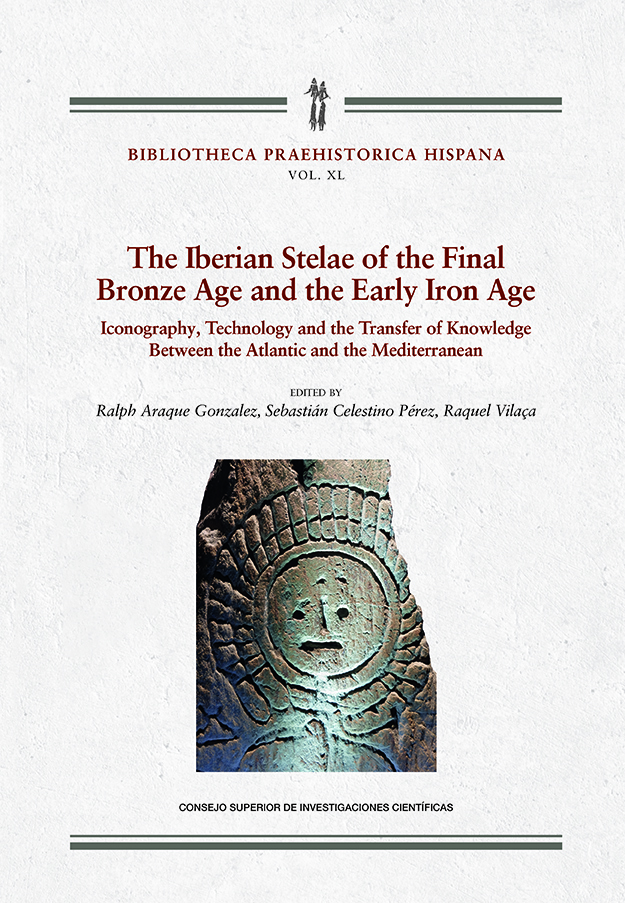
The Iberian stelae of the Final Bronze Age and the Early Iron Age : iconography, technology and the transfer of knowledge between the Atlantic and the Mediterranean
Ralph Araque Gonzalez (edicion) Affiliation: Not available Biography: Ralph Araque Gonzalez (Garmisch-Partenkirchen [Germany], 1978) is Principal Investigator of the project “The Iberian stelae of the Final Bronze Age: Iconography, technology and the transfer of knowledge between the Atlantic and the Mediterranean”, funded by the German Research Foundation (DFG project no. 446739573) at the University of Freiburg, IAW, Department of Prehistory. He has worked on archaeological sites in Austria, Corsica, Germany, Ireland, Portugal, Sardinia, Sicily, Spain, Switzerland and Venezuela. His research interests focus on the Late Bronze Age and Early Iron Age in Western and Mediterranean Europe, rock art, prehistoric figurines and sculpture, intercultural communication and contacts, the archaeology of technology and labour, social archaeology, conflict archaeology, and prehistoric contacts between Africa and Europe. He focussed on the western Iberian stelae in his dissertation, among other expressions of Bronze and Iron Age iconography, and has published various papers on the topic. He is currently investigating problems of prehistoric stone working technologies and the earliest iron metallurgy with multidisciplinary approaches, including, most importantly, experimental archaeology and material analyses. After obtaining his MA in Prehistory and Anthropology in 2007, he was awarded a PhD in 2016 with the dissertation “Intercultural Communications and Iconography in the Western Mediterranean during the Late Bronze Age and the Early Iron Age”, both at the University of Freiburg (Germany). He is a member of the Africa Centre for Transregional Research (ACT). Sebastíán Celestino Pérez (edicion) Affiliation: Consejo Superior de Investigaciones Científicas. Instituto de Arqueología (Mérida, Badajoz, España). Biography: Doctor en Filosofía y Letras por la Universidad Autónoma de Madrid. Es investigador científico del CSIC y director del Instituto de Arqueología (CSIC - Junta de Extremadura). Es responsable del grupo de investigación del CSIC \\\"Arqueología del urbanismo, la arquitectura, el paisaje y la imagen\\\". Especialista en la cultura tartésica ha escrito varios libros y numerosos artículos sobre este tema y, en general, sobre la protohistoria del suroeste peninsular. Ha dirigido varios proyectos del Plan Nacional I+D+i; el último, Construyendo Tarteso, tiene como objetivo el estudio arquitectónico de los edificios en tierra de época tartésica. Ha dirigido varias excavaciones arqueológicas, donde destacan especialmente la del santuario de Cancho Roano y el monumento de Casas del Turuñuelo de Guareña. Raquel Vilaça (edicion) Affiliation: Not available Biography: Raquel Vilaça (Coimbra [Portugal], 1958) was awarded her PhD by the University of Coimbra (1995) with the thesis Aspectos do Povoamento da Beira Interior (Centro e Sul) nos Finais da Idade do Bronze, published in Trabalhos de Arqueologia, 9, IPPAR, Lisbon, a work which received the “Gulbenkian Prize for Archaeology” (1997). She is Full Professor in the same university. She teaches and supervises works in the Archaeology courses (BA, MA, and PhD), and she is the Director of the PhD in Archaeology. She is a member of the Institute of Archaeology, which she has also directed, and she was editor of its journal, Conimbriga. She is researcher of the CEAACP/FCT – Centre for Studies in Archaeology, Arts and Heritage Sciences. She currently coordinates or has coordinated scientific projects, and participates or has participated as a researcher in several others, both nationally and internationally. Likewise, she is or has been a scientific consultant for various research and heritage projects. She is responsible for the excavation of more than 30 archaeological sites and countless survey works. Her research is focused on Prehistoric and Protohistoric Archaeology, particularly on the study of the Bronze and Iron Ages in Iberia. Her academic interests also include Settlement and Landscape Archaeology, stelae, the Archaeology of the Atlantic World, archaic technology and metallurgy, archaeometry, death processes and materialities, as well as ritual, cultic, and symbolic expressions, fields in which she has published books and papers, in Portugal and abroad. |
Edition: Ralph Araque Gonzalez; Sebastíán Celestino Pérez; Raquel Vilaça About the authors Publication year: 2025 Language: English Subjects: Archaeology and Prehistory Collection: Bibliotheca Praehistorica Hispana Free eBook |


Abstract:
The western Iberian stelae from the Final Bronze Age and Early Iron Age transition (c. 1200-550 BC) are rock art monuments that superbly represent the complex triangular relationship between culture, technology and communication. This book presents contributions from a multidisciplinary team of researchers and craftspeople to the comprehensive investigation of these monuments within their cultural and chronological contexts. The approaches encompass geo-archaeology, petrology, experimental archaeology, landscape archaeology and visual culture studies. Moreover, the technologies of prehistoric stone working and possible tools used for stelae making are examined by archaeometallurgical analyses, experimental replications, and traceology.
This combined methodology goes beyond the traditional study of the motifs and their compositions on the stelae, seeking to re-evaluate the rock supports and the reasons for their choice, explore the technologies used for their production, and discover the symbolic significance of these stelae for the communities who created them. Eventually, this research considers the perspectives of stonemasonry, bronze and iron met-allurgy, and technology transfer. This has resulted in new insights on the social and cultural implications of the Western Iberian stelae, the emergence of early Iberian iron metallurgy, technology transfer, innovation, and intercultural contacts between the Mediterranean and the Atlantic at the dawn of history.
Table of Contents  (0.09 Mb)
Preview (0.19 Mb)
Bibliographic information
Physical Description : 262 p. : 32 cm
ISBN: 978-84-00-11532-6
eISBN: 978-84-00-11533-3
Publication: Madrid : Consejo Superior de Investigaciones Científicas, 2025
Reference CSIC: 14411
Buy the digital edition atThis eBook is available for free download Buy the print edition at |
Free DownloadsDownload eBook |
This book was added to our online catalog on Thursday 26 February, 2026.



